Walk through a mining operation or a construction site, and you will see the same thing. Machines built like tanks. They have to be. The frames, gearboxes and housings inside that equipment take a beating that would shatter consumer-grade components. When those parts fail, equipment stops. And when equipment stops, money bleeds out by the minute.
At Blackhawk Engineering, we spend our days making sure that does not happen. We provide large part machining services for components that weigh up to 2000 pounds. It is heavy work that demands heavy iron and the people who know how to run it.
The Equipment That Handles the Weight
You cannot machine a 2000-pound steel housing on a benchtop mill. It takes machines that weigh ten times as much as the parts they cut. That is what we have on our floor.
Our Mazak Flexible Manufacturing System sits at the heart of our operation. These are 5-axis machining centers with the capacity to handle parts up to 1450mm in diameter and 1600mm tall. When a component comes in with compound angles and surfaces that need machining on multiple sides, this equipment reduces the number of setups significantly. In some cases, we can run a job in a single operation. Fewer setups mean fewer chances for error and fewer tolerances to manage. It also means the part leaves the machine closer to finished, which gets it out the door faster.
We also run twelve 800mm Horizontal Machining Centers. These machines handle bulkier pieces like main bearing caps and suspension components, especially those made from grey and ductile iron castings. When you are machining large parts, holding tight tolerances across every surface matters. These machining centers are built to handle that demand. They deliver the consistency needed when a casting has to fit against another component on an assembly line.
For the round stuff, we go to our vertical spindle lathes. These things crank out 75 horsepower and turn parts up to 49.2 inches in diameter. Shafts, collars and large cylindrical components find their home on these machines. The power behind the spindle lets us take heavier cuts, which knocks minutes off cycle times.
Fixtures That Hold Firm
Here is the thing about large part machining: the part wants to move. It has mass. It has inertia. When the cutter engages, that mass fights back. If your fixturing cannot control that fight, the part walks. Tolerances walk with it.
Our guys design and build fixtures specific to each job. We think about where the forces hit and how to counteract them. We think about how to hold a 2000-pound chunk of iron without distorting it, because clamping pressure alone can tweak a part if you are not careful. Then you machine it perfectly, unclamp it and it springs out of tolerance. We have been doing this long enough to know where those problems hide.
Moving the Monsters
Getting a 2000-pound part to the machine is a problem unto itself. You do not hand-carry these things. You do not sling them with a chain hoist and hope for the best.
Our shop is set up with forklift-ready part-handling systems. That means we design our work flow around how these heavy parts move. Fixtures get positioned for forklift access. Machine beds sit at heights that make sense for loading. We keep the path from the receiving dock to the machine clear and organized. When you handle parts this size every day, you build the shop around them. You do not try to fit them into a shop built for smaller work.
What Comes Off Our Machines
We machine a lot of iron. Ductile iron, gray iron, cast iron. We also cut plenty of steel: 1018, 1045, 4140, 4340, 8620. These are the materials that go into equipment meant to last.
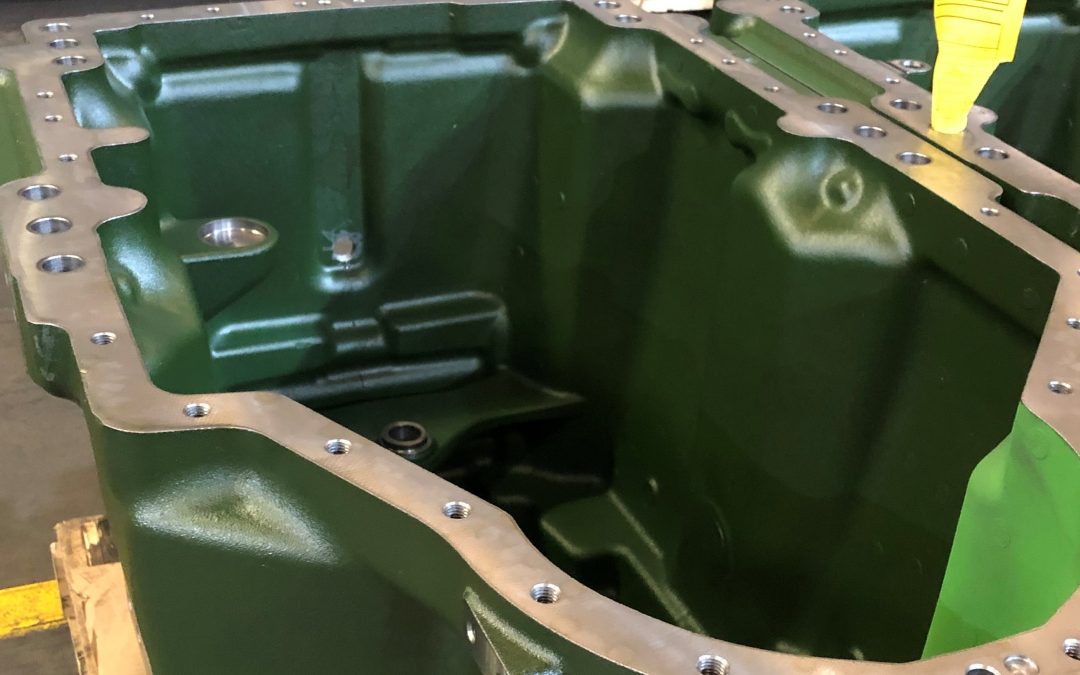
The parts themselves tend to be drivetrain-type components. Gear cases. Housings. Engine components. Axle parts. Hydraulic manifolds and valve bodies. These are not cosmetic pieces. They are structural. They carry load. They transfer power. They have to fit right the first time because there is no adjustment once they are bolted into a $500,000 machine.
Checking the Work
Machining a big part is only half the battle. You have to prove it is right.
We run every critical component through our coordinate measuring machines. These are Brown & Sharpe and Sheffield CMMs with 5-axis REVO heads. They can measure parts up to 2000mm by 3300mm by 1500mm. We scan the part and compare it to the CAD model. If something is off, we catch it before it ships. We do not guess. We do not eyeball it. We measure it and send the report with the part.
Why It Matters
Industries like mining, construction and wind energy do not have time for returns. When a piece of equipment goes down, they need the replacement part to fit and work. Not next week. Now. Our job is to make sure that happens.
We have been doing this for over 50 years. We have the equipment. We have the fixtures. We have the part-handling systems. But mostly, we have the guys who know how to run it all. They watch the tools, listen to the machines and catch the small problems before they become big ones.
If you have large parts that need machining, give us a call. Bring us your prints. Bring us your castings. We will handle the rest.
